AI to Contribute $15.7 Trillion to Global Economy by 2030
Zak
17 May 2025
AI is expected to add $15.7 trillion to the global economy by 2030, according to PwC's Sizing the Prize report. That's more than the current combined output of China and India, and it would make global GDP up to 14% higher than it would otherwise be.
Below: where that money comes from, which countries and industries get the biggest share, and what it means if you run IT or network infrastructure today.
Key Takeaways
- AI is projected to add $15.7 trillion to the global economy by 2030
- Productivity gains account for $6.6 trillion of that figure
- Consumption-side effects make up the remaining $9.1 trillion
- China and North America capture almost 70% of the total
- Healthcare, financial services, and manufacturing stand to gain the most
Breaking Down the $15.7 Trillion
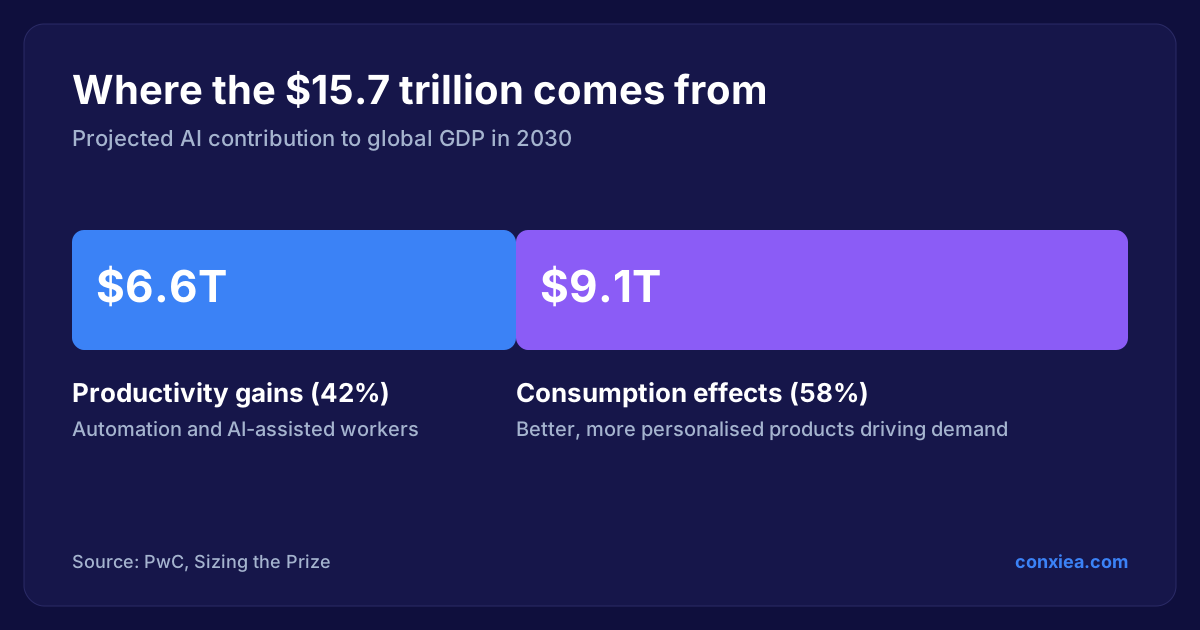 Bar chart: $6.6 trillion from productivity gains and $9.1 trillion from consumption effects
The headline figure comes from two distinct drivers:
Productivity gains, $6.6 trillion Businesses using AI to automate tasks, reduce errors, and speed up operations. Think diagnostics in healthcare, underwriting in finance, and predictive maintenance in manufacturing. PwC expects these to drive most of the early gains, because automating existing work is faster than inventing new products.
Consumption effects, $9.1 trillion AI enables better, more personalised products and services. As quality improves and costs fall, consumers buy more, and that demand is what overtakes productivity gains towards 2030.
The same split happens on a smaller scale inside IT teams. The first wins from AI are almost always productivity, fewer manual tasks and faster fixes, which is exactly what AIOps platforms are built to deliver.
Where AI Will Create the Most Value
Healthcare

AI is transforming how conditions are diagnosed and treated. Machine learning models can detect diseases earlier than traditional methods, and administrative automation is reducing the cost burden on healthcare systems significantly. None of it works without reliable networks underneath, which is why we've written separately about network automation for healthcare.
Financial Services

AI-powered credit assessment, fraud detection, and personalised financial planning are already reshaping how financial institutions operate, and how consumers access services. Banks also have some of the strictest uptime and compliance requirements, see network automation in financial services.
Manufacturing & Logistics
Predictive maintenance, intelligent supply chains, and automated quality control are cutting costs and reducing waste at scale across the sector. The idea of fixing a fault before it causes downtime applies just as well to networks, it's the principle behind self-healing network infrastructure.
Who Captures the Gains
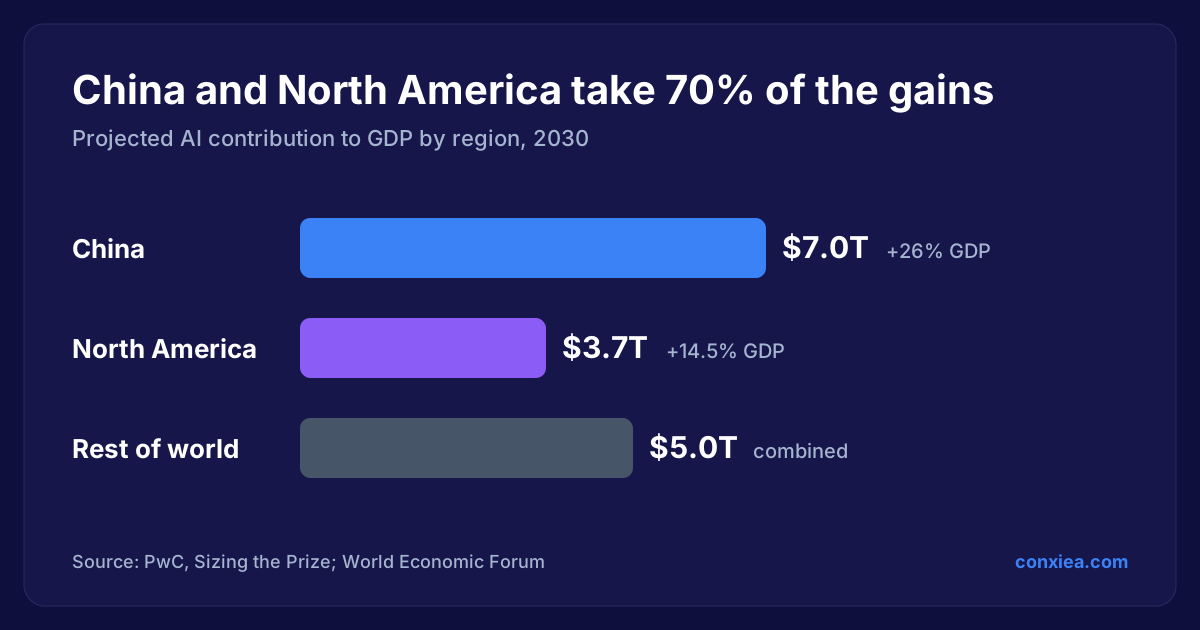 Bar chart: China $7.0 trillion, North America $3.7 trillion, rest of world $5.0 trillion
PwC expects China to see the biggest boost, with GDP up to 26% higher by 2030, worth around $7 trillion. North America follows at roughly 14.5%, around $3.7 trillion. Between them, the two regions account for almost 70% of the global impact (World Economic Forum).
Europe and developed Asia see smaller but still significant gains. The key difference won't just be who has the best models. It will be who has the infrastructure, the data, and the talent to deploy them at scale.

The Employment Question
AI's impact on jobs is complex. It isn't simply "AI takes jobs", the reality is more nuanced:
Roles most at risk:
- Repetitive data processing
- Basic customer service
- Manual quality control
New roles emerging:
- AI model development and maintenance
- Data science and analytics
- AI ethics and governance
The businesses that invest in upskilling now will be better positioned to absorb the change rather than be disrupted by it. In networking, that shift is already visible: engineers are moving from manual config work into automation, see our network automation career roadmap and Python for network engineers.
What This Means for Businesses Today
The $15.7 trillion won't arrive evenly or automatically. It will flow to organisations that adopt AI strategically, not just bolt on a chatbot and call it done. The early movers will capture disproportionate gains in efficiency, customer experience, and competitive positioning.
For infrastructure teams, that means AI-driven network automation, intelligent monitoring, and self-healing systems are no longer a nice-to-have. The numbers behind that are in our AIOps statistics for 2026: the average minute of downtime now costs around $15,000, and over half of organisations struggle to hire the network engineers they need.
If you're not sure where to start:
- Learn the basics: What is network automation?
- Pick a first project: What network operations to automate first
- Build the business case: AIOps ROI and payback
Conclusion
AI's $15.7 trillion contribution to the global economy by 2030 is not a distant projection, it's already underway. The productivity gains are measurable today, and the consumption effects are accelerating as AI-powered products become mainstream.
The question for businesses isn't whether AI will change the economy. It already is. The question is whether you're positioned to benefit from it, or just watching it happen.
Want to see what AI automation looks like on your own infrastructure? Explore the Conxiea AI InfraOps platform or get in touch with the team.


